


| Proxy Statement | 5 |
| How You Can Vote | 6 |
| Expenses and Solicitation | 7 |
| Change or Revocation of Proxy | 7 |
| Quorum | 8 |
| Vote Required for Approval of the Proposal | 9 |
| Security Ownership of Certain Beneficial Owners and Management | 9 |
| Proposal 1 — Approval of Amended and Restated Compensation Policy | 11 |
| Background | 12 |
| Tower’s Growth Since Approval of the 2023 Compensation Policy | 12 |
| Shareholder Engagement Following the July 2026 Meeting | 14 |
| Amended Compensation Policy | 15 |
| Market Benchmarking Framework | 20 |
| Global/U.S. Compensation Peer Group | 21 |
| The Updated Peer Group | 22 |
| Actual Equity Grant Benchmarking | 23 |
| Benchmarking Equity Caps in Compensation Policies Adopted Under the Israeli Companies Law | 24 |
| Governance Safeguards | 27 |
| The Board’s Decision to Return the Matter to Shareholders | 28 |
| Proposal / Approval Required / Board Recommendation | 29 |
| Additional Information | 30 |
| Forward-Looking Statements | 30 |
| Other Business | 31 |
| Exhibit A — Amended and Restated Compensation Policy | A-1 |

Extraordinary General Meeting of Shareholders — To be Held on November 25, 2026
This proxy statement (the “Proxy Statement”) is being furnished to the holders of ordinary shares, par value NIS 15.00 per share (the “Ordinary Shares”), of Tower Semiconductor Ltd. (“we,” “us,” “our,” the “Company” or “Tower”) in connection with the solicitation of proxies by the Board of Directors of the Company (the “Board of Directors” or the “Board”) for use at the Extraordinary General Meeting of Shareholders (the “Meeting”) to be held at the offices of the Company, 20 Shaul Amor Street, Ramat Gavriel Industrial Park, Migdal Haemek 2310502, Israel, on November 25, 2026 at 3:00p.m. (Israel time), or at any postponement or adjournment thereof.
The Meeting has been convened for the sole purpose of considering and voting upon the approval of an amended and restated compensation policy for the Company’s directors and executive officers (the “Amended Compensation Policy”), in accordance with the requirements of the Israeli Companies Law, 1999 (the “Israeli Companies Law”).
The Board of Directors recommends that you vote “FOR” the proposal on the agenda.
You are entitled to vote at the Meeting if you are a shareholder of record at the close of business on October 19, 2026 (the “Record Date”). You are also entitled to vote at the Meeting if you hold Ordinary Shares through a bank, broker or other nominee which is one of our shareholders of record at the close of business on the Record Date or which appears in the participant listing of a securities depository on that date and if you hold Ordinary Shares through a member of the Tel Aviv Stock Exchange (“TASE”) on that date. You can vote your Ordinary Shares by attending the Meeting or by following the instructions under “How You Can Vote” below. Our Board urges you to vote your Ordinary Shares so that they will be counted at the Meeting or at any postponements or adjournments thereof.
This Proxy Statement, and the accompanying Notice of Extraordinary General Meeting of Shareholders describing the matter to be voted upon at the Meeting along with a proxy card enabling the shareholders to indicate their vote on such matter, are being furnished to the U.S. Securities and Exchange Commission (the “Commission”) as an exhibit to Form 6-K and are available on the Commission’s website at www.sec.gov. This Proxy Statement and the accompanying Notice of Extraordinary General Meeting of Shareholders are also being filed with the Israel Securities Authority (“ISA”) and the TASE and are available on their websites at www.magna.isa.gov.il and maya.tase.co.il, respectively. This Proxy Statement will also be available on our website www.towersemi.com.

How You Can Vote
Whether or not you plan to attend the Meeting, we urge you to vote by proxy to ensure your vote is counted. You may still attend the Meeting if you vote by proxy.
Record Holders. Shareholders of record can vote either in person at the Meeting or by proxy (whether or not you attend the Meeting), by completing, dating, signing and returning the enclosed proxy card in the postage-paid envelope provided. These proxy materials are being sent directly to shareholders of record. All Ordinary Shares represented by a properly executed proxy in the form enclosed received prior to the Meeting (that is not revoked in accordance with the procedures described in this Proxy Statement) will be voted in accordance with the instructions of the shareholder executing the proxy. A shareholder may vote in favor of, against, or may abstain from voting on, the proposal set forth in this Proxy Statement and the accompanying Notice of Meeting. Shareholders should specify their choice on the accompanying proxy card. If no specific instruction is given with respect to the matter to be acted upon, the shares represented by a properly signed proxy will be voted FOR the proposal set forth in the accompanying Notice of Meeting.
Beneficial Holders. If you are a beneficial owner of shares (i.e., you hold shares in “street name”), these proxy materials are being forwarded to you together with a voting instruction form by the broker, trustee or nominee or an agent hired by the broker, trustee or nominee. Please complete, date, sign and return your voting instruction form in the postage-paid envelope provided by your brokerage firm, bank or other similar organization, or, if the brokerage firm, bank or other similar organization offers Internet or telephone voting, please follow the instructions on the voting instruction form to vote via Internet or telephone. To vote your shares directly at the Meeting, as a beneficial holder you must obtain a “legal proxy” from the broker, trustee or nominee that holds your Ordinary Shares, giving you the right to vote the shares at the Meeting.
Shares Traded on the TASE. A shareholder whose shares are registered with a TASE member may vote in person at the Meeting or via proxy. Shareholders who hold shares through a TASE member are entitled to receive from the TASE member who holds the shares on the shareholder’s behalf, by e-mail, for no charge, a link to the text of the proxy card, unless the shareholder has given notice that he or she or it is not so interested or is interested in receiving the proxy card by mail for a delivery fee, provided that these instructions must apply to the entire securities account of the shareholder (not to specific securities held within the account) and are provided prior to the Record Date. Shareholders who hold shares through members of the TASE (whether attending the Meeting in person or voting via proxy) must present at the Meeting or deliver to the Company an ownership certificate issued by the applicable TASE member confirming their ownership of our Ordinary Shares as of the Record Date, as required by the Israeli Companies Regulations (Proof of Ownership of Shares for Voting at General Meeting) of 2000, as amended. Alternatively, shareholders who hold Ordinary Shares through a TASE member may also vote electronically via the electronic voting system of the ISA (the “Electronic System”) after receiving a personal identifying number, an access code and additional information regarding the Meeting from the relevant TASE member and after carrying out a secured identification process, up to six hours before the time set for the Meeting.

Expenses and Solicitation
The Board is soliciting proxies for use at the Meeting. We expect to solicit proxies by mail and to mail this Proxy Statement and the accompanying proxy card to shareholders as soon as practicable after the Record Date. Proxies may also be solicited in person, by telephone or electronic communication, by our directors, officers and employees. We will bear the cost of the preparation and mailing of proxy materials and the solicitation of proxies. We will, upon request, reimburse banks, brokerage houses, other institutions, nominees, and fiduciaries for their reasonable expenses in forwarding solicitation materials to beneficial owners in accordance with the regulations of the Commission.
Change or Revocation of Proxy
Any shareholder of record at the close of business on the Record Date that has returned the accompanying proxy may revoke such proxy at any time prior to the Meeting by: (i) giving written notice to us of such revocation; (ii) voting in person at the Meeting or requesting the return of the proxy at the Meeting; or (iii) executing and delivering to us a later-dated proxy prior to the Meeting. Written revocations and later-dated proxies should be sent to the Company at 20 Shaul Amor Street, Ramat Gavriel Industrial Park, Post Office Box 619, Migdal Haemek 2310502, Israel, Attention: Corporate Counsel. Attendance at the Meeting will not cause your previously granted proxy to be revoked unless you specifically so request.
If your shares are held in “street name,” you should follow the directions of, or contact, your broker, bank, trustee or nominee if you wish to revoke or modify previously submitted voting instructions or, if you have obtained a legal proxy from your broker, bank, trustee or nominee giving you the right to vote your shares, by attending the Meeting and voting in person.
If your shares are held through a member of the TASE, you may change your voting instructions (i) by attending the Meeting and voting in person, by presenting a valid ownership certificate (as of the Record Date); (ii) by delivering a later-dated duly executed proxy, together with a valid ownership certificate (as of the Record Date), to the Company’s offices; or (iii) by following the relevant instructions for changing your vote via the Electronic System by no later than six hours before the time set for the Meeting.
Quorum
Two or more shareholders present, in person, by proxy or voting instruction form or voting via the Electronic System, who hold or represent together at least 33% of the voting rights of our issued share capital will constitute a quorum for the Meeting. If within half an hour of the time scheduled for the Meeting a quorum is not present, the Meeting shall stand adjourned for one week, to December 2, 2026, at the same time and place, without it being necessary to notify the shareholders. If a quorum is not present at the adjourned Meeting within half an hour of the scheduled time, the persons present, in person, by proxy or voting instruction form or voting via the Electronic System (regardless of the voting power represented by their shares), shall collectively constitute a quorum.

Abstentions and broker non-votes will be counted towards the quorum. Broker non-votes occur when brokers that hold their customers’ shares in street name sign and submit proxies for such shares and vote such shares on some matters but not on others. This occurs when brokers have not received any instructions from their customers, in which case the brokers, as the holders of record, are only permitted to vote on “routine” matters, and not on non-routine matters (such as the approval of the Amended Compensation Policy). Because the approval of the Amended Compensation Policy is the only matter on the agenda for the Meeting, and brokers cannot vote on it without instructions from their customers as it is not a “routine” matter, we do not expect there to be any broker non-votes at the Meeting. Unsigned or unreturned proxies, including those not returned by banks, brokers, or other record holders, will not be counted for quorum purposes.
Vote Required for Approval of the Proposal
Voting Requirement Summary
✓ Ordinary vote: a majority of the Ordinary Shares represented at the Meeting and voting on the matter.
✓ Special Majority (also required): either (a) a majority of the shares voted by non-controlling and non-interested shareholders (excluding abstentions), or (b) opposing votes cast by non-controlling and non-interested shareholders do not exceed 2% of the Company’s total voting rights.
Each Ordinary Share is entitled to one vote on the matter to be voted on at the Meeting.
The affirmative vote of holders of a majority of the Ordinary Shares represented at the Meeting and voting on the matter, in person or by proxy, voting instruction form or via the Electronic System, is required to approve the proposal.
In addition, under the Israeli Companies Law, the approval of the proposal is also subject to the fulfillment of one of the following additional voting requirements: (i) at least a majority of the Ordinary Shares of the non-controlling shareholders and shareholders who do not have a personal interest in the matter (excluding abstentions), voted in favor of the proposal; or (ii) the total votes cast in opposition to the proposal by the non-controlling shareholders and non-interested shareholders do not exceed 2% of the total voting rights in the Company (the “Special Majority”).

As of the filing date of this Proxy Statement, we are not aware of any shareholder that would be deemed to be a controlling shareholder of the Company for purposes of the proposal. Under the Israeli Companies Law, each shareholder voting on the proposal is required to inform us prior to voting on the proposal at the Meeting, whether or not such shareholder has a “personal interest” (within the meaning of the Israeli Companies Law) in such proposal; otherwise, a shareholder’s vote will not be counted for the purposes of such proposal. However, in accordance with regulations promulgated under the Israeli Companies Law, a shareholder who votes by proxy or voting instruction form will be deemed to have confirmed that such shareholder does not have a “personal interest” in the proposal, unless the shareholder has delivered a written notice to the Company notifying otherwise no later than 10:00 a.m. (Israel time) on November 25, 2026. Any such written notice must be sent to the Company via registered mail at 20 Shaul Amor Street, Ramat Gavriel Industrial Park, Post Office Box 619, Migdal Haemek 2310502, Israel, Attention: Corporate Counsel. All shareholders voting via the Electronic System are required to indicate via the Electronic System, or, if voting in person at the Meeting, inform us prior to voting on the matter at the Meeting, whether or not the shareholder has a personal interest in such proposal; otherwise, any such shareholder’s vote will not be counted for the purposes of such proposal.
Under the Israeli Companies Law, a “personal interest” of a shareholder in an act or transaction of a company (i) includes a personal interest of (a) any of the shareholder’s relatives (i.e., any spouse, sibling, parent, grandparent or descendant of the shareholder, any descendant, sibling or parent of a spouse of the shareholder and the spouse of any of the foregoing); and (b) a company with respect to which the shareholder or any of the shareholder’s relatives (as defined above) owns at least 5% of the outstanding shares or voting rights, serves as a director or chief executive officer or has the right to appoint one or more directors or the chief executive officer; and (ii) excludes a personal interest arising solely from the ownership of shares. Under the Israeli Companies Law, in the case of a person voting by proxy, “personal interest” includes the personal interest of either the proxy holder or the shareholder granting the proxy, whether or not the proxy holder has discretion how to vote.
Security Ownership of Certain Beneficial Owners and Management The table below provides information relating to the beneficial ownership of our Ordinary Shares as of September 30, 2026 (unless otherwise indicated), by each shareholder known by us to beneficially own 5% or more of our Ordinary Shares.
Beneficial ownership is determined according to the rules of the Commission, and the information is not necessarily indicative of beneficial ownership for any other purpose. Under such rules, beneficial ownership includes any shares over which the individual or entity possesses sole or shared voting or investment power of that security, or the right to receive the economic benefit of ownership, as well as any shares that the individual has the right to acquire beneficial ownership within 60 days of September 30, 2026, such as through the exercise of any option, warrant or other right or vesting of restricted share units or performance share units.

The percentage of Ordinary Shares beneficially owned is calculated based on 113,517,666 Ordinary Shares outstanding as of September 30, 2026. Ordinary Shares that a person has the right to acquire within 60 days of September 30, 2026 are deemed outstanding for purposes of computing the beneficial percentage ownership of the person holding such securities but are not deemed outstanding for purposes of computing the beneficial ownership percentage of any other person.
| Name of Beneficial Owner | Ordinary
Shares Beneficially Owned |
%
of Shares Outstanding |
| (1) Harel Insurance Investments & Financial Services | 7,164,672 | 6.31% |
| (2) T. Rowe Price Associates, Inc. | 7,022,980 | 6.19% |
| (3) Migdal Insurance & Financial Holdings Ltd | 6,964,713 | 6.14% |
| (4) Phoenix Holdings Ltd. | 6,494,565 | 5.72% |
| (5) Menora Mivtachim Holdings Ltd. | 6,281,979 | 5.53% |
- Based solely upon, and qualified in its entirety with reference to, a notice provided to the Company by Harel Insurance Investments & Financial Services., reflecting holdings as of September 30, 2026.
- Based solely upon, and qualified in its entirety with reference to, a notice provided to the Company, by T. Rowe Price Associates, Inc., reflecting beneficial ownership as of June 30, 2026.
- Based solely upon, and qualified in its entirety with reference to, a notice provided to the Company by Migdal Insurance & Financial Holdings Ltd., reflecting holdings as of September 30, 2026.

- Based solely upon, and qualified in its entirety with reference to, a notice provided to the Company by Phoenix Holdings Ltd reflecting holdings as of September 30, 2026.
- Based solely upon, and qualified in its entirety with reference to, a notice provided to the Company by Menora Mivtachim Holdings Ltd. reflecting holdings as of September 30, 2026.
As of September 30, 2026, no individual director or senior manager beneficially owned (as defined in Rule 13d-3 under the Securities Exchange Act of 1934, as amended) one percent or more of our Ordinary Shares.
Proposal 1
APPROVAL OF AMENDED AND RESTATED COMPENSATION POLICY FOR DIRECTORS AND EXECUTIVE OFFICERS Executive Summary What’s being voted on: approval of an amended and restated compensation policy for Tower’s directors and executive officers, as required every three years under the Israeli Companies Law.
Why now: the Company’s most recent compensation policy for officers and directors, approved by the shareholders at the annual general meeting held in July 2023 and subsequently amended by the shareholders in July 2024 (the “2023 Compensation Policy”) reached the end of its three-year term, and a revised compensation policy presented at the July 2026 annual general meeting of shareholders (the “July 2026 Proposed Policy”) did not receive the required shareholder approval.
What changed: following an extensive shareholder engagement process and review of benchmark and related information, the Compensation Committee and the Board of Directors withdrew two proposed modifications from the July 2026 Proposed Policy: (1) an increase in the Chief Executive Officer’s maximum potential bonus upside opportunity, and (2) an increase in the maximum permitted sign-on bonus for executive officers, maintaining both elements at the 2023 Compensation Policy levels. No other provision of the July 2026 Proposed Policy was modified and no new provision has been proposed.
Board recommendation: FOR.

Background
Under the Israeli Companies Law, a public company is required to adopt a compensation policy, which sets forth the terms of service and employment of directors and officers, including the grant of any benefit, payment or undertaking to provide payment, any exemption from liability, insurance or indemnification, and any severance payment or benefit. The compensation policy must be approved at least once every three years by the board of directors, after considering the recommendations of the compensation committee, and by the shareholders by the Special Majority (see above, “Vote Required for Approval of the Proposal”). In addition, the board of directors is required to periodically examine the compensation policy, as well as the need to adjust the policy in the event of a material change in the circumstances prevailing at the time of the adoption of the compensation policy or for other reasons.
The Company’s most recent compensation policy, the 2023 Compensation Policy, approved by the shareholders at the annual general meeting held in July 2023 and subsequently amended by the shareholders in July 2024, reached the end of its three-year approval term in July 2026, and therefore, the Company is required under the Israeli Companies Law to obtain renewed shareholder approval of a compensation policy.
Accordingly, during the first half of 2026, the Compensation Committee and Board of Directors conducted an extensive review of the 2023 Compensation Policy and retained FW Cook, an independent global compensation consultant, to perform executive compensation benchmarking, provide advisory services regarding prevailing global trends in executive compensation, and recommend changes to the 2023 Compensation Policy that aim to enable Tower to attract and retain the talent it needs to continue executing on the Company’s business strategy and growing shareholder value. Following this review, the July 2026 Proposed Policy was presented for shareholder approval at the July 2, 2026 annual general meeting of shareholders (“July 2026 Meeting”); however, the proposal for its approval did not receive the requisite majority under the Israeli Companies Law at the July 2026 Meeting and, accordingly, was not approved by the shareholders.
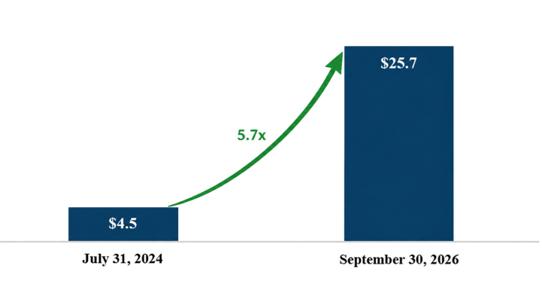
Tower’s Growth Since Approval of the 2023 Compensation Policy Since the adoption of the 2023 Compensation Policy in July 2023 and the subsequent shareholder-approved amendment in July 2024, the Company has experienced significant growth and transformation in market share, capacity, and revenue, driven in large part by the rapid expansion of artificial intelligence (AI), data center infrastructure, and radio frequency (“RF”) infrastructure. During this period, the scale of the Company’s business, the complexity of its operations, the differentiation and strategic importance of its technology and intellectual property, and its importance to market leaders and top-tier customers have all increased dramatically. Furthermore, the Company’s market capitalization increased to $25.7 billion as of September 30, 2026 from $4.5 billion when the 2023 Compensation Policy was last amended by the shareholders on July 31, 2024, representing an increase of 471%


In addition, after the July 2026 Meeting, during the third quarter of 2026, the Company announced that it was raising its 2028 target business model to $3.6 billion in revenue and $1.2 billion in net profit. The 2028 revenue target represents a 130% increase over $1.566 billion in revenue achieved in 2025 and the 2028 net profit target represents a 445% increase over $0.22 billion in net profit achieved in 2025.
| 2028 Target | 2028 Target | ||
| 2025 | Business Model | vs. 2025 Actual | |
| Revenue ($B) | $1.566 | $3.6 | 2.3x |
| Net Profit ($B) | $0.22 | $1.2 | 5.4x |
| Net Profit Margin | 14.1% | 33.3% | 2.4x |


Shareholder Engagement Following the July 2026 Meeting
Following the July 2026 Meeting, the Compensation Committee and the Board of Directors carefully reviewed the outcome of the shareholder vote and the feedback received regarding the July 2026 Proposed Policy. As part of this review, the Company conducted a broad shareholder engagement process to better understand the concerns underlying the vote and to identify potential changes to the 2026 Proposed Compensation Policy that may more closely align the Company’s compensation framework with shareholder expectations.
The Company contacted 26 shareholders, representing approximately 49% of the Company’s outstanding Ordinary Shares, and held discussions with 11 shareholders, representing approximately 29% of the Company’s outstanding Ordinary Shares. The Chair of the Compensation Committee, the Company’s Chief Legal Officer and the Company’s Senior Vice President of Investor Relations, Public Relations and Human Resources participated in these discussions.
Shareholders with whom the Company held discussions generally expressed support for the Company, its management and its progress to date in terms of business development, growth and shareholder value. They noted that it would be helpful to receive additional information, to the extent possible, to assess the rigor of performance targets and the alignment of pay with performance.

The feedback received through this engagement was reviewed by the Compensation Committee and the Board of Directors and informed their further consideration of the changes that had been proposed in the July 2026 Proposed Policy. Following this process, the Compensation Committee and the Board of Directors determined to withdraw two of the proposed amendments included in the July 2026 Proposed Policy and to submit the resulting amended and restated compensation policy to shareholders for approval (the “Amended Compensation Policy”).
The full text of the Amended Compensation Policy is attached as Exhibit A to this Proxy Statement, marked to show the changes from the 2023 Compensation Policy as amended by shareholders in July 2024.
Amended Compensation Policy
The Amended Compensation Policy being submitted for approval at the Meeting is substantially similar to the July 2026 Proposed Policy, with two important changes, each of which withdraws a proposed amendment and preserves the corresponding provision included in the 2023 Compensation Policy, following discussions with shareholders and review of other information. No new provision has been introduced, and no other provision of the July 2026 Proposed Policy has been modified.
What Changed Since the July 2026 Meeting
✓ Withdrawn: Chief Executive Officer increase in maximum potential bonus upside opportunity. The Amended Compensation Policy withdraws the increased potential bonus upside for the Chief Executive Officer that was proposed in the July 2026 Proposed Policy. Accordingly, the Chief Executive Officer’s maximum bonus upside opportunity will remain at the level provided in the 2023 Compensation Policy, of 21 months’ salary for the “A” portion (based on measurable Company criteria) and 3 months’ salary for the “B” portion (based on individual performance), which level has not changed since the first compensation policy that was adopted by the Company in 2013.
✓ Withdrawn: Increased maximum permitted sign-on bonus grant. The Amended Compensation Policy withdraws the increased maximum permitted sign-on bonus that was proposed in the July 2026 Proposed Policy. Accordingly, the maximum permitted sign-on bonus will remain at the level provided in the 2023 Compensation Policy, namely, cash or equity with an aggregate value of up to one annual base salary, which level includes any potential make-whole awards and has not changed since the first compensation policy that was adopted by the Company in 2013.
The compensation policy establishes a framework of maximum permitted limits and does not require the Company to approve or pay any specific amount of actual compensation. The actual compensation granted to the Company’s executive officers has never reached the maximum permitted total compensation limits. The compensation policy provides the Compensation Committee and the Board of Directors with the ability to design competitive compensation arrangements within these caps, providing the flexibility needed to navigate the highly competitive global talent landscape and support shareholder value creation. The Amended Compensation Policy being brought for approval at the Meeting is intended to ensure that the Company can continue to attract, retain, and motivate the leadership talent necessary to support the Company’s continued growth and enhance its long-term value.

The following is a summary of the amendments reflected in the Amended Compensation Policy, as compared to the 2023 Compensation Policy, as amended by shareholders in July 2024. The summary is qualified in its entirety by reference to the full text of the proposed Amended Compensation Policy, which is attached as Exhibit A to this Proxy Statement.
| Section | Topic | Summary of Amendment |
| 4.2 | Fixed-to-Variable Compensation Ratio | The ratio of fixed compensation to total variable compensation that may be awarded over a calendar year has been updated, due to the proposed increase in the maximum value of equity awards and the additional performance-based equity awards that may be granted, to 1:20 for the Chief Executive Officer and 1:14 for each Other Executive Officer. |
| 9.3 | MBO Metric Weightings and Payout Curve (1) | The possible weightings applicable to the executive performance objectives (“MBO”) metric categories for purposes of the annual bonus have been broadened to provide the Compensation Committee and the Board of Directors with greater flexibility and to enable consideration of external factors and special emphasis on certain metrics when providing the Company with guidelines for the establishment of future year(s) MBOs, such as the ability to increase the weighting of the financial performance goals, as shown in the table below. |
| Metrics | 2023 Compensation Policy |
2026
Amended Compensation Policy |
| Financial | 30–70% | 40–90% |
| Business - Strategic and Tactical | 15–50% | 0–50% |

| Operations | 10–40% | 0–40% |
| Human Resources | 5–15% | 0–15% |
The MBO payout matrix sets a minimum threshold for each metric below which no payout is made for that metric. A proportional payout of between 50% and 100% of target is made for MBO scores between the applicable minimum threshold (70% for the Chief Executive Officer and 65% for the Other Executive Officers) and 1.0 (target performance), and an increased payout is made for upside performance with an MBO score above 1.0, with the maximum payout under this portion of the annual bonus capped at 140% of target for a score of 1.3 or above. There is linear interpolation between all points. No payout is made under this portion of the annual bonus for the overall MBO score below the applicable minimum threshold.
| Performance Level | Corporate
MBO Score |
CEO
Payout as % of Target |
| Below Threshold | <0.70 | 0% |
| Threshold | 0.7 | 50% |
| Target | 1 | 100% |
| Maximum | 1.30+ | 140% |
| Performance Level | Corporate MBO Score | Other
Executive Payout as % of Target |
| Below Threshold | <0.65 | 0% |
| Threshold | 0.65 | 50% |
| Target | 1 | 100% |

| Maximum | 1.30+ | 140% |
| 10.2 / 10.3 | Additional Bonus Thresholds | In order to enhance the rigor and focus of the performance targets, a provision has been added that allows the Board of Directors to add additional minimum performance threshold(s) below which no bonus payout will be paid to the Chief Executive Officer or to the Other Executive Officers, respectively, regardless of the total MBO score achieved. This provision will enable the Compensation Committee and the Board of Directors to emphasize criteria of particular importance in a given year by defining it as required minimum performance for any bonus payout. The maximum bonus upside for the Chief Executive Officer remains unchanged from the 2023 Compensation Policy. |
| 14.3 | Maximum Annual Equity Award Value (2) | The maximum value of equity, calculated in accordance with the Equity Calculation Model (as defined in the Amended Compensation Policy), that may be granted annually to the Chief Executive Officer has been increased to an amount equal to 13 times the Chief Executive Officer’s annual base salary, and, with respect to each Other Executive Officer, to an amount equal to 7 times such Other Executive Officer’s annual base salary, in order to enable the Company to provide its executive officers with competitive market compensation that aligns with the compensation practices of its peer group. |
| 14.6 | Equity Vesting on Death | It has been clarified that performance-based restricted share units will vest at target performance in the event of acceleration of equity awards due to death. |
| 14.8 | Shareholding Guidelines Compliance | The shareholding guidelines have been updated to reflect the current compliance of all officers and directors who have served on the Board of Directors since the Board adopted the guidelines, and to clarify that officers and directors elected or appointed (as applicable) subsequent to the date on which the Board of Directors approved the shareholding guidelines are required to attain full compliance with the guidelines in accordance with the same mechanism and time period, with the necessary applicable changes. |
| 16.2 | Severance Pay for Israeli Officers | It has been clarified that severance pay may not be paid to Israeli executive officers upon dismissal if severance pay is not payable under applicable Israeli law. |

| 18 | Qualified Retirement Program | A qualified retirement program has been added, under which equity awards held by eligible executive officers of long tenure may continue to vest for up to a specified period following qualified retirement if the executive officer notifies the Company of his or her desire to leave employment with the Company under the terms of the program, including the agreement of the executive officer to a certain transition period (for the Company’s benefit) and to certain post-separation restrictive covenants, including non-competition, non-solicitation, non-disparagement and confidentiality undertakings. |
| 21 | D&O Insurance Coverage Limit | The maximum aggregate limit of liability under directors’ and officers’ insurance that may be procured by the Company from time to time has been increased from up to $130 million to up to $175 million per claim and in the aggregate for each insurance period, in accordance with benchmark data for similarly situated companies. This level remains in the lower range of the applicable industry benchmark. |
| 22 | Interim Director Equity Grant | An interim service equity grant has been added for newly appointed directors whose appointment to the Board of Directors was approved by the Board of Directors more than three months prior to the Company’s next annual general meeting of shareholders. In accordance with the Israeli Companies Law and our Articles of Association, the Board of Directors may appoint a director to serve on the Board until the Company’s next annual general meeting of shareholders; however, the 2023 Compensation Policy does not provide for the grant of equity-based compensation to such a director in respect of such interim service period. |
(1) For reference, for the 2026 annual bonuses, the measurable criteria that comprise the “A” portion of the annual bonus are weighted as follows: financial metrics - 40%, with revenue and net profit together comprising more than 50% of the financial metrics; business and strategic metrics (including human resources) - 35%; and operational metrics - 25%. The actual payout for the “A” portion of the annual bonus as a percentage of the target payout was 106% for 2025 (MBO score of 1.046), 125% for 2024 (MBO score of 1.187), and 92% for 2023 (MBO score of 0.953). The Company will consider providing additional disclosures in its annual reports with respect to the achievement of the pre-defined measurable bonus targets.
(2) The Company plans to provide additional disclosure in its annual reports with respect to achievement of the pre-defined equity performance targets after the conclusion of each performance period.

Market Benchmarking Framework
In connection with the Amended Compensation Policy, the Compensation Committee and the Board of Directors, assisted by FW Cook, evaluated market practice through two complementary benchmarking lenses:
| Market Reference | Primary Question | How It Is Used |
Compensation Peer Group Global/U.S. compensation peer group |
What compensation opportunities are provided in the global semiconductor market in which Tower competes for executive talent? | Benchmarks pay practices among similarly-sized semiconductor, semiconductor equipment/materials, and adjacent photonics companies. This peer group is necessary because there are very few Israeli companies that are in a relevant industry and have comparable financial size and scale to Tower. |
Israeli Law Reference Group U.S.-listed companies subject to Israeli Companies Law |
What forward-looking compensation authority do the compensation policies of similarly governed public companies provide? | Benchmarks Tower’s proposed compensation policy caps with the caps in these companies’ compensation policies, after standardizing caps expressed in different forms to allow comparison on a like-for-like basis. These companies’ most recently disclosed actual chief executive officer equity grants are also reviewed as an additional check. |
This approach is important because most U.S. domestic issuers hold a retrospective, non-binding advisory vote on named executive officer compensation; but are not required to adopt binding, forward-looking limits on executive compensation components. By contrast, as customary for Israeli companies, Tower’s Compensation Policy sets maximum limits on director and executive officer compensation, establishing the boundaries within which the Compensation Committee and the Board of Directors may act.
The two-market reference approach helps the Compensation Committee understand both competitive compensation in Tower’s global semiconductor talent market, and whether the compensation caps included in the proposed Amended Compensation Policy in accordance with Israeli law requirements are reasonable relative to those included in compensation policies of similarly governed issuers.

Market data were used as reference points rather than as formulas or automatic entitlements. Actual compensation decisions continue to reflect Company and individual performance, role scope, retention and succession considerations, internal equity and applicable corporate approvals, subject to the limits within our Compensation Policy.
Global/U.S. Compensation Peer Group
In October 2026, the Compensation Committee and the Board of Directors with the assistance of FW Cook, reviewed the Company’s existing 17-company compensation peer group, and approved an updated 17-company compensation peer group. The review was undertaken because Tower’s market capitalization had increased substantially since the previous peer group review in the fall of 2025 and several existing peers had become too small relative to Tower (including some that had agreed to be acquired). As a result, six companies were removed and six were added to the peer group, preserving a 17-company sample while improving the group’s alignment with Tower’s financial profile.
The updated peer group remains closely aligned with Tower’s industry and executive talent market: nine companies are semiconductor companies, five are semiconductor equipment and materials companies, and three are adjacent high-technology hardware companies focused on photonics and optical communications. The Compensation Committee expanded the industry scope beyond semiconductors to maintain market capitalization and financial size discipline, since obtaining a robust number of peers using only semiconductor companies would have required adding companies that are significantly larger or smaller than Tower.
The Compensation Committee considered industry relevance, market capitalization, revenue, operating income, and employee headcount when selecting peers. Market capitalization was given a high weighting because we believe it is most-closely associated with executive pay opportunity and company-wide equity budgets, while the other measures provide important context regarding operating scope and organizational complexity.
The updated peer group consists of companies in relevant industries that are within reasonable size ranges relative to Tower, selected primarily on the basis of the following criteria:
- Similar industries – U.S.-listed semiconductor, semiconductor equipment/materials, and adjacent photonics companies
- Similar market capitalization - $10 billion to $60 billion 12-month average market capitalization through September 30, 2026, which is 0.4x to 2.3x Tower’s $25.7 billion market capitalization on September 30, 2026
- Similar revenue - $0.65 billion to $7.1 billion of trailing four-quarter revenue disclosed as of September 30, 2026, representing approximately 0.4x to 4.2x Tower’s latest-disclosed trailing four-quarter revenue of $1.71 billion (through June 30, 2026). The Compensation Committee also considered then-current third-party 2026 analyst consensus revenue estimates for Tower as an additional reference point in assessing Tower’s present scale.

The updated peer group consists of companies listed on U.S. exchanges because certain of the Company’s executives officers are based in the United States, the Company’s Chief Executive Officer was recruited from the United States and has served in that role since 2005, and other executive officer positions are held by non-Israelis. In addition, the United States is the Company’s largest reported geographic region by revenue, and there are few Israeli public companies of comparable scale in the semiconductor or related high-technology sector, whether listed on Nasdaq, another U.S. exchange, or the TASE. Further, over the past five years, approximately two-thirds of the average daily trading volume in the Company’s Ordinary Shares has occurred on Nasdaq, and approximately one-third has occurred on the TASE. A local geographic adjustment to the benchmark data is considered when evaluating pay for Tower’s executive officers who are not based in the U.S.
2027 Peer Group
The updated peer group that the Compensation Committee adopted is set forth below:
| Advanced Energy Industries, Inc. (SME) | MKS Inc. (SME) |
| Ciena Corporation (POC) | Monolithic Power Systems, Inc. (S) |
| Coherent Corp. (POC) | ON Semiconductor Corporation (S) |
| Credo Technology Group Holding Ltd (S) | Qnity Electronics, Inc. (SME) |
| Entegris, Inc. (SME) | Rambus Inc. (S) |
| Lattice Semiconductor Corporation (S) | Semtech Corporation (S) |
| Lumentum Holdings Inc. (POC) | Skyworks Solutions, Inc. (S) |
| MACOM Technology Solutions Holdings, Inc. (S) | Teradyne, Inc. (SME) |
| Microchip Technology Incorporated (S) |
(S) = Semiconductors
(SME) = Semiconductor Materials & Equipment
(POC) = Photonics / Optical Communications

As shown in the table below, Tower’s market capitalization as of September 30, 2026 is aligned with the updated peer group median, which the Compensation Committee considered in assessing the limits proposed under the Amended Compensation Policy:
| $ values in millions | Market
Cap - 12- Month Average Through September 30, 2026 (1) |
Market
Cap - On September 30, 2026 |
Revenue (2) |
| 75th Percentile | $46,690 | $49,891 | $5,122 |
| Median | $25,066 | $26,306 | $3,326 |
| 25th Percentile | $14,254 | $17,842 | $1,591 |
| Tower Percentile Rank | 45P | 49P | 27P |
(1) For reference, Tower’s trailing 12-month average market capitalization through September 30, 2026 was $19.6 billion.
(2) Tower's $1.71B trailing four quarter revenue through June 30, 2026 is compared to peers' trailing four quarters revenue based on latest disclosures available on September 30, 2026.
Actual Equity Grant Benchmarking
The Compensation Committee compared the maximum annual equity values proposed under the Amended Compensation Policy, 13 times annual base salary for the Chief Executive Officer and 7 times annual base salary for each Other Executive Officer, with actual annual equity grants among the updated global/U.S. peer group. For Other Executive Officers, the comparison is based on equity grants to the peer companies’ chief financial officers, because compensation data for that role are disclosed consistently across the peer group, making it the closest available comparison.
As shown in the graph below, Tower’s proposed equity limit of 13 times annual base salary for the Chief Executive Officer is consistent with the peer group median for the most recently disclosed actual annual equity grants to chief executive officers, and Tower’s proposed limit of 7 times annual base salary for each Other Executive Officer is closely aligned with the peer group median of 6.7 times annual base salary for the most recently disclosed actual annual equity grants to chief financial officers. The Compensation Committee believes that this demonstrates the reasonableness of the proposed equity limits in the proposed Amended Compensation Policy, which allows Tower to be competitive with the mid-range of the market, but not meaningfully above it.


The limits of 13 times and 7 times annual base salary set the maximum annual equity awards permitted under the Amended Compensation Policy during its three-year term. They are not target amounts, and the Company is not required to grant any specific sized award; actual awards may be lower. In addition, any equity award to the Chief Executive Officer or a director remains subject to the approvals required under Israeli law, including separate shareholder approval.
Benchmarking Equity Caps in Compensation Policies Adopted Under the Israeli Companies Law The Compensation Committee also reviewed the compensation policy equity limits of the 11 largest-cap companies that are subject to the Israeli Companies Law and traded on a U.S. exchange, each with a market capitalization above $3 billion as of September 30, 2026, as listed below. This group is not intended to represent Tower’s executive talent market because very few of these companies are comparable to Tower in terms of both size and industry (the median market capitalization was only $7.2 billion as of September 30, 2026). Rather, it provides a governance reference for the forward-looking compensation authority provided to compensation committees and boards of directors operating under the same statutory compensation-policy framework.

The Israeli Law Reference Group
The reference group of companies that the Compensation Committee reviewed to assess the reasonableness of the proposed Amended Compensation Policy equity limits is set forth below:
Market Capitalization on | ||
| Company* | Industry | September 30, 2026 ($B) |
| Teva Pharmaceutical Industries Limited | Pharmaceuticals | $46.1 |
| Elbit Systems Ltd. | Aerospace and Defense | $31.4 |
| Check Point Software Technologies Ltd. | Software | $13.1 |
| Nova Ltd. | Semiconductor Materials and Equipment | $12.2 |
| JFrog Ltd. | Software | $12.0 |
| Camtek Ltd. | Semiconductor Materials and Equipment | $7.2 |
| Global-E Online Ltd. | Broadline Retail | $6.7 |
| ICL Group Ltd | Chemicals | $6.5 |
| NICE Ltd. | Software | $6.3 |
| monday.com Ltd. | Software | $3.3 |
| Wix.com Ltd. | IT Services | $3.0 |
| Median | $7.2 | |
| Tower | Semiconductors | $25.7 |
| Tower Percentile Rank | 87P | |
| *Sample excludes Enlight Renewable Energy Ltd because its annual equity cap was not calculable | ||
Because the Israeli reference group companies express their equity limits in different forms, including percentages of market capitalization, fixed dollar values, salary multiples and formulas using more than one measure, FW Cook standardized the disclosed limits into two common measures: (i) the implied dollar value as of September 30, 2026, and (ii) a percentage of market capitalization as of September 30, 2026. This allowed the limits to be compared on a consistent basis, regardless of how each reference group company’s policy expresses them. Based on this analysis, FW Cook found that Tower’s proposed equity limits are well below the median of the Israeli reference group.

As reflected in the graph below, Tower’s proposed limit of (i) 13 times annual base salary for the Chief Executive Officer, which equals $14.06 million, is equivalent to 0.05% of Tower’s $25.7 billion market capitalization on September 30, 2026, compared with the Israeli reference group median of 0.25%; and (ii) 7 times annual base salary for each Other Executive Officer is equivalent to 0.01% of Tower’s market capitalization, which is also well below the reference group median of 0.13%.
The Compensation Committee believes that Tower’s use of salary-multiple limits also provides a meaningful structural constraint: unlike a compensation policy limit expressed solely as a percentage of market capitalization, Tower’s permitted equity grant value does not increase automatically in direct proportion to changes in its market capitalization.

In addition, the Compensation Committee reviewed the most recently disclosed actual equity grants to the chief executive officers of the Israeli reference group companies and found that the median award was equivalent to 13 times annual base salary, with the 25th percentile at 5.6 times and the 75th percentile at 22.7 times annual base salary. This further supports the Compensation Committee’s view that a limit of 13 times annual base salary is a reasonable equity limit for the Company’s Chief Executive Officer under the proposed Amended Compensation Policy.

Governance Safeguards
The Amended Compensation Policy retains each of the governance safeguards contained in the 2023 Compensation Policy. In particular, under the Amended Compensation Policy:
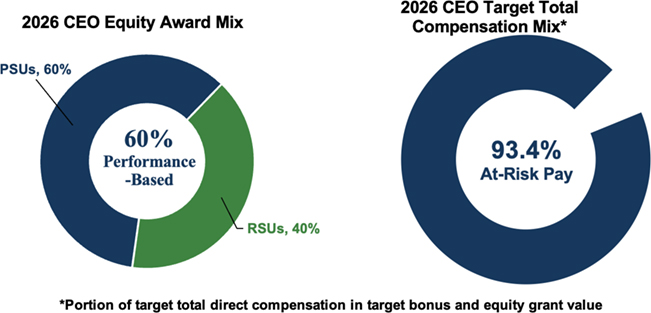
- The majority of executive long-term incentive compensation continues to be performance-based restricted share units. More than half of the value of the Chief Executive Officer’s and Other Executive Officer’s annual equity awards is required to be in the form of performance share units, and 100% of all upside equity awards must be performance share units and may be earned only upon the overachievement of pre-defined performance targets. Furthermore, 60% of the Chief Executive Officer’s actual 2026 equity grant is in performance-based equity, and approximately 93% of the Chief Executive Officer’s 2026 target total direct compensation is at-risk, which is defined as the sum of the target bonus and the equity grant value:
- The total number of shares underlying outstanding restricted share units, performance share units and other equity-based compensation awards granted by the Company may not, at any time, exceed 10% of the Company’s share capital on a fully diluted basis. The Company’s annual burn rate averaged 0.9% of the Company’s weighted average ordinary shares outstanding, and its outstanding equity awards on December 31, 2025 were 1.9% of the Company’s ordinary shares outstanding on that date.

| Equity Compensation Share Burn Rate | ||||
| 2022 | 2023 | 2024 | 2025 | |
| Equity awards granted | 612,881 | 797,241 | 1,581,492 | 781,952 |
| Weighted average ordinary shares outstanding | 109,349,000 | 110,289,000 | 111,153,000 | 111,981,000 |
| Share burn rate | 0.6% | 0.7% | 1.4% | 0.7% |
- Annual bonuses are tied to pre-established performance metrics and to minimum performance thresholds below which no bonus is earned.
- Executive and director share ownership guidelines remain in place and compliance is enforced. The Chief Executive Officer is required to hold Ordinary Shares with a minimum value equal to at least three times his annual base salary, and directors and executive officers are each required to hold Ordinary Shares with a minimum value equal to at least 50% of their respective annual cash fees or annual gross base salary, respectively.
- The Company’s clawback policy, adopted in accordance with the Commission’s regulations and the Nasdaq Listing Rules, remains in effect.
- The grant of compensation, including equity-based awards, to the Chief Executive Officer and the directors, continues to require the approval of the Compensation Committee, the Board of Directors and the shareholders (subject to limited exceptions).
The Compensation Committee and the Board of Directors have consistently been attentive to shareholders’ interests and intend to remain so, and will continue to monitor and, as appropriate, adapt to prevailing market best practices.
The Board’s Decision to Return the Matter to Shareholders
Subsequent to the shareholder vote at the July 2026 Meeting, the Compensation Committee and the Board of Directors reviewed and evaluated the shareholder feedback to the July 2026 Proposed Policy, as described above, following which they determined that it would be appropriate and in the best interests of the Company and its shareholders to submit the Amended Compensation Policy to the shareholders for approval.
If the Amended Compensation Policy is approved at the Meeting, then in accordance with the Israeli Companies Law it must be re-approved by shareholders within three years of such date, and shall be subject to periodic assessments by our Board of Directors in accordance with the Israeli Companies Law.

Proposal
It is therefore proposed that at the Meeting, the following resolution be adopted:
“RESOLVED, to approve the Amended Compensation Policy, in the form attached as Exhibit A to the Proxy Statement.”
Approval Required
The approval of this proposal requires the affirmative vote of holders of a majority of the Ordinary Shares represented at the Meeting and voting on the matter, in person or by proxy, voting instruction form or via the Electronic System. In addition, under the Israeli Companies Law, the approval of this proposal is also subject to the fulfillment of the Special Majority. For additional details, see “Vote Required for Approval of the Proposal” above.
Board Recommendation
The Board of Directors recommends that shareholders vote “FOR” the approval of the foregoing resolution.

Additional Information
We are subject to the informational requirements of the U.S. Securities Exchange Act of 1934, as amended (the “Exchange Act”), as applicable to foreign private issuers. Accordingly, we file reports and other information with the Commission. As a foreign private issuer, all documents furnished or filed with the Commission after November 4, 2002, are available for retrieval on the Commission’s website at www.sec.gov. We submit copies of our filings with the Commission to the ISA and the TASE, and such filings are also available to the public on their respective websites at www.magna.isa.gov.il and www.maya.tase.co.il. Website references throughout this document are provided for convenience only, and the content on the referenced websites is not incorporated by reference into this proxy statement.
As a foreign private issuer, we are exempt from the rules under the Exchange Act prescribing certain disclosure and procedural requirements with respect to proxy solicitations. The circulation of this Proxy Statement and accompanying notice should not be taken as an admission that we are subject to those proxy rules. Furthermore, our officers, directors and principal shareholders are exempt from the “short-swing” profit recovery provisions contained in Section 16(b) of the Exchange Act and the rules thereunder, with respect to their purchases and sales of securities. In addition, we are not required under the Exchange Act to file periodic reports and financial statements with the Commission as frequently or as promptly as United States companies whose securities are registered under the Exchange Act.
Forward-Looking Statements
This Proxy Statement includes certain “forward-looking” statements within the meaning of Section 21E of the Exchange Act. The use of words such as “projects,” “expects,” “may,” “target,” “plans,” “intends,” “committed to,” or words of similar import, identifies a statement as “forward-looking.” There can be no assurance, however, that actual results will not differ materially from our expectations or projections. Factors that could cause actual results to differ from our expectations or projections include the risks and uncertainties relating to our business described in “Item 3. Key Information—D. Risk Factors” of our Annual Report on Form 20-F for the year ended December 31, 2025, filed with the Commission on April 30, 2026.
We remind readers that forward-looking statements are merely predictions and therefore are inherently subject to uncertainties and other factors and involve known and unknown risks that could cause the actual results, including revenues from agreements we signed, expansion of our operations, performance, activities, and our achievements, to be materially different from any forecasted results, plans to expand our operations, plans to develop and release new products, forecasted performance, planned activities, or targeted achievements expressed or implied by such forward-looking statements. Readers should not place undue reliance on these forward-looking statements, which speak only as of the date of this Proxy Statement. Unless legally required, we undertake no obligation to update publicly any forward-looking statements, whether as a result of new information, future events or otherwise.

Other Business
Other than as set forth above, management knows of no business to be transacted at the Meeting. If any other matters are properly presented at the Meeting, Ordinary Shares represented by executed and unrevoked proxies will be voted by the persons named in the enclosed form of proxy upon such matters in accordance with their best judgment.
By Order of the Board of Directors,
Amir Elstein
Chairman of the Board
Migdal Haemek, Israel
October 13, 2026

Exhibit A
Amended and Restated Compensation Policy for Directors and Executive Officers
COMPENSATION POLICY
TOWER SEMICONDUCTOR LTD.
Compensation Policy for Executive Officers and Directors
A. Overview and Objectives
- Introduction
This document sets forth the compensation policy for Executive Officers and Directors (both as defined herein) of Tower Semiconductor Ltd. ("Tower" or the "Company"), in accordance with the requirements of the Companies Law (this "Compensation Policy" or "Policy").
Compensation is a key component of Tower’s overall human capital strategy to attract, retain, reward, and motivate highly skilled individuals who will enhance Tower's value and otherwise assist Tower to reach its business and financial long term goals. The Policy is designed to provide the Compensation Committee and Board of Directors the tools and mechanisms to incentivize the Executive Officers and promote the Company’s growth plans. Accordingly, the structure of this Policy is established to tie the compensation for each Executive Officer to Tower's goals and performance.
This Compensation Policy will be in effect for a period of three (3) years from the date the Policy is duly approved under the Companies Law.
The Compensation Committee and the Board of Directors of Tower shall review and reassess the adequacy of this Policy from time to time, as required by the Companies Law.
In setting the compensation of the Executive Officers and Directors, the Compensation Committee and the Board of Directors shall consider, among other things, the following factors:
- the educational, professional experience and accomplishments of the Executive Officer or Director;
- the Executive Officer or Director's position, responsibilities and prior compensation arrangements;
- compensation data for comparably situated executives at peer companies, including companies in the industry and/or geographic market;
- data of other senior executives of the Company;
- macroeconomic environment;
- Company's own performance;
- the Executive Officer or Director's expected contribution to the Company’s future growth and profitability;
- the relationship between the compensation paid to the Executive Officer or Director and the average and median compensation of the Company’s employees and contractors, as well as whether such variation has an effect on employment relations; and
- any requirements prescribed by applicable law from time to time.

- Objectives
Tower’s objectives and goals in setting this Compensation Policy are to maintain competitiveness by attracting, motivating and retaining highly talented and experienced personnel with the necessary capabilities to promote creativity and manage global operations. These abilities are critical to Tower's long-term success in order to provide leadership, and enhance shareholder value, while supporting a performance culture that is based on merit, motivates individuals to perform at their highest level, differentiates and rewards excellent performance, and recognizes Tower's values. Due to Tower's unique position as an Israeli company with a global footprint, it aims to adopt compensation policies and procedures that match global companies of similar complexity, including semiconductor companies and other companies which compete with Tower for similar talent, and companies in the relevant geographical location, while complying with applicable local laws and customs as well. Executive Officers’ or Directors’ total compensation may deviate from target level where required to attract or retain individuals or reflect their respective characteristics or performance.
To that end, this Policy is designed, among others:
| 2.1. | To closely align the interests of the Executive Officers and Directors with those of Tower’s shareholders in order to enhance shareholder value; |
| 2.2. | To provide the Executive Officers and Directors with a structured compensation package, including competitive salaries and performance-based cash and equity incentive programs; |
| 2.3. | To maintain and increase the level of motivation and ambition and promote for each an opportunity to advance in a growing organization and strive for excellence; |
| 2.4. | To provide appropriate awards for superior individual and corporate performance; |
| 2.5. | To improve the business results and increase income and profitability over time; and |
| 2.6. | To support the implementation of the Company's business strategy. |
- Compensation structure and instruments
Compensation instruments under this Compensation Policy may include the following:
| 3.1. | Base salary; |
| 3.2. | Benefits and perquisites; |
| 3.3. | Performance-based cash bonuses; |
| 3.4. | Equity based compensation; and |
| 3.5. | Retirement, termination and other arrangements. |
- Ratio between variable and fixed compensation
| 4.1. | This Policy aims to optimize the mix of Fixed Compensation and Variable Compensation (both as defined herein) in order to, among other things, appropriately incentivize Executive Officers to meet Tower's goals while considering Tower's management of business risks. |
| 4.2. | As a rule, the total of the Variable Compensation to be given to an Executive Officer over a calendar year relative to the Fixed Compensation shall not exceed the “Executive Ratio” which shall be 1720 for the CEO and 114 for Other Executive Officers. The Executive Ratio is calculated based on the following assumptions: (i) maximal possible payments that may be made to Executive Officers under the Variable Compensation covered by this Policy (bonuses and equity); (ii) any CEO relocation related reimbursement expenses included under Fixed Compensation and assuming no relocation expenses for any Other Executive Officer; and (iii) excluding any potential sign-on bonuses for new hires. The variable component in regard of the equity compensation reflects the annual amortization over the vesting period. |

- Inter-Company Compensation Ratio
In the process of composing this Policy, the possible ramifications of the Employee Ratio on the work environment in Tower were examined in order to ensure that levels of executive compensation, as compared to the overall workforce, will not have a negative impact on work relations in Tower.
B. Base Salary, Benefits and Perquisites
- Base Salary
| 6.1. | The base salary varies between Executive Officers, and is individually determined according to the past performance, educational background, place of residence, prior business experience, qualifications, specializations, situation, role, business responsibilities and achievements of the Executive Officer and the previous salary arrangements therewith. |
| 6.2. | Since a competitive base salary is essential to Tower's ability to attract and retain highly skilled professionals, Tower will seek to establish and maintain base salaries that are based on competitive market analyses. The comparative peer group will include direct competitors, or companies that operate in similar industries, with similar market capitalization, enterprise value, and/or revenues, active in similar geographic locations. |
- Benefits and Perquisites
| 7.1. | Executive Officers will be entitled to benefits stated as such by relevant law and best practice for peer companies. |
| 7.2. | Executive Officers may also be entitled to additional benefits, taking into consideration their rank, seniority in the territory they reside in, market and local practice and legislation. Such additional benefits, which shall be subject to approval of the Compensation Committee and the Board of Directors, may include, inter alia, annual vacation, sick leave, medical insurance, allocations to pensions, long term disability, -contribution to an education fund (up to the maximum allowable by law), car expenses, contribution to managers' insurance, cellular phone and laptop computer, as well as taxes and expenses which may be incurred in relation to such benefits being borne by the Company. |
| 7.3. | In addition, when relevant, and subject to approval of the Compensation Committee and the Board of Directors, Executive Officers may be entitled to relocation related expenses and benefits until termination, including housing costs, family flights and related repatriation costs, which shall not exceed $280,000 on an annual basis. |
C. Cash Bonuses
- Sign-on Bonus
| 8.1. | For purposes of attracting high quality personnel, Tower may offer an Executive Officer a sign-on bonus as an incentive to join the Company. |
| 8.2. | The sign-on bonus may be comprised of cash and/or equity and shall not exceed an amount equal to the Executive's Officer's annual base salary. Any equity based compensation to be granted as part of a sign-on bonus shall be subject to the vesting and expiration periods, as well as the other terms with respect to equity set forth in Section 14 below. |
| 8.3. | The sign-on cash bonus will be paid half on signing the employment contract and half will be paid on the second anniversary from the signing date, subject to continued employment with Tower during said two year period. -In the event the employee resigns or is terminated for cause before the end of said two (2) year period, the first half of said cash bonus may be clawed back and repaid to the Company. |

- Annual Bonus - The Objective, Components and Threshold
| 9.1. | Compensation in the form of cash bonus(es) is an important element in aligning Executive Officers' compensation with Tower's objectives and business goals in the long-term, such that both individual performance and overall company success are rewarded. |
| 9.2. | Tower's policy is to allow annual cash bonuses, which may be awarded to the Executive Officers upon the attainment of pre-set annual measurable objectives and personal performance, which are set in the first quarter of the year, and include minimum thresholds for performance, as well as individual and/or division/department performance goals and personal development goals for Other Executive Officers. |
| 9.3. | A pre-defined mechanism will include bonus criteria based on the following components, with the weight (in percentage terms) of each group of measures as a portion of the annual criteria as set out below: |
A = Corporate MBO Score (as defined herein) that is calculated in any year based on Tower financial/operational/strategic measures (subject to bonus threshold criteria), such as the criteria specified below, which score can range from 0 to 1.5. Each measure has 3 points: threshold, base and maximum.
- Financials metrics: 340-790%, including categories such as:
- Revenue
- EBITDA
- Cash balance
- Net profit
- Specific annual balance sheet cap-table related metrics, focused on increasing shareholders' value, such as balance sheet ratios, refinancing, restructurings.
- Business - Strategic & tactical : 150-50%, including categories such as:
- Existing customers and revenue funnel which is the base for the following years' revenue growth
- Business Units major strategic programs
- Specific M&A targets
- Annual specific major tactical customer driven activities
- Customer support, including categories such as top customers scorecards feedback
- Operations : 10-40%, including categories such as:
- Cost
- On time delivery
- Quality
- Other measurable manufacturing indices
- Safety
- Annually specific activities (such as capacity increase)
- HR: 50-15%, including categories such as:
- Employee turnover
- Talent programs' success
- Employees' satisfaction
B = score granted to the Executive Officer after an evaluation of his/her individual performance, considering the position of the Executive Officer and the contribution of the Executive Officer to the achievement of the Company's targets. The B score will result in a bonus (not subject to the bonus threshold) as described below.
| 9.4. | General bonus threshold – if the Corporate MBO Score is less than the applicable score set forth in Section 10 below, no bonus will be granted for the “A” component of the Corporate MBO Score in such year. |

- The Formula
| 10.1. | The annual bonus will be based on the measurable objectives of the Company as described above. Such measurable criteria will be determined for each fiscal year as a function of the annual operating plan that is approved by the Board of Directors before the end of the first quarter of each year, and will include financial, operational and strategic measures, on the basis of the balance between long term and short term considerations. |
| 10.2. | The annual bonus of the CEO will be calculated using the below formula: |
CEO monthly actual base salary x [A + B] = Total Payout
For the "A" component applicable to this Section 10.2, after meeting the minimum threshold which enables a bonus, multiple sections (financial/operational/strategic measures) will have individual weights and criteria, with the weight (in percentage terms) of each measure as a portion of the annual criteria, such that the total "A" component of the bonus shall be set at 7.5 months, 15 months and 21 months of the CEO’s monthly base salary for "A" scores of 0.7, 1.0 and 1.3, respectively. Between each two of the abovementioned scores, the "A" component shall be calculated linearly based on the Corporate MBO Score. The maximum bonus amount under the "A" component is capped at 21 months of the CEO's monthly base salary for any "A" score of 1.3 or above.
For the "B" component, a bonus with an annual cap of 3 monthly base salaries may be granted according to the chairman of the board of director's recommendation in regard to an evaluation of the CEO's individual performance, and subject to Compensation Committee and Board of Directors approval.
The minimum threshold for the entitlement of the CEO to receive the bonus under the "A" component is a weighted average Corporate MBO Score of 0.7. The Board of Directors may define additional threshold(s) at its discretion. The entitlement for the "B" component of the cash bonus has no minimal threshold.
| 10.3. | The annual bonuses of Other Executive Officers will not exceed the Executive Maximum Amount, subject to the Executive Ratio described in 4.2 above. |
| 10.4. | The minimum threshold for the entitlement of the Other Executive Officers to receive the bonus under the "A" component is a weighted average Corporate MBO Score of 0.65. The Board of Directors may define additional threshold(s) at its discretion. The entitlement for the "B" component of the cash bonus has no minimal threshold. Achievement of the individual and/or division/department performance goals and personal development goals of the Other Executive Officers may have a minimum threshold according to the CEO’s discretion. |
| 10.5. | The Compensation Committee and Board intend to review, discuss and approve management recommendation for the specific Corporate MBO objectives which recommendation shall be made in the first quarter of each fiscal year with respect to such year, and which if met shall entitle the Executive Officers to an annual bonus for his/her performance in such year. Notwithstanding the foregoing, the CEO shall be entitled to determine and approve the annual measurable objectives, individual and/or division/department performance goals and personal development goals for the Other Executive Officers, which if met shall entitle the Other Executive Officers to an annual bonus for his/her performance in such year, in which case the CEO shall update and report to the Compensation Committee on such objectives and goals of the Other Executive Officers so established. |
- Special bonus for special achievements
| 11.1. | Executive Officers may receive a special bonus for substantial achievements on special transactions that are unexpected when determining the Company's annual MBO plan as defined below, following recommendation and approval of the Compensation Committee and Board. It is clarified that this special bonus mechanism will not be awarded as a matter of routine and granted only in situations where it is warranted as described below. |

Special transactions shall include M&A Transactions (defined below) with financial or strategic parties as well as transactions in which third parties enter into binding agreements pursuant to which they undertake to invest in the Company or its subsidiaries, new business models/joint development projects, customer financed large technology and new technology entrance, equity or debt financing, restructure the Company's debt or which include a “take or pay” commitment or which transaction includes a “pre-payment” basis.
| 11.2. | Such special bonus shall not exceed the amount of four (4) monthly salaries of each applicable Executive Officer and the entitlement for this bonus has no minimal threshold condition. |
- Compensation Recovery ("Clawback")
| 12.1. | In the event that an Executive Officer was paid any compensation based on erroneous data which is later restated in the Company’s financial statements within a period of three (3) financial years prior to the date of the correction, the Company shall be entitled to recover from such Executive Officer any compensation in the amount of the excess of the compensation that the Executive Officer received over what he/she should have been paid on the basis of the restated financial statements. |
| 12.2. | Notwithstanding the aforesaid, the compensation recovery will not be triggered in the event of a financial restatement required due to changes in the applicable financial reporting standards. |
| 12.3. | The Compensation Committee will be responsible for approving the amounts to be recouped and for setting terms for such recoupment from time to time. |
| 12.4. | In addition, the Company has adopted an incentive compensation claw-back policy in accordance with rules of the U.S. Securities and Exchange Commission and Nasdaq Stock Market. |
D. Equity Based Compensation
- The Objective
| 13.1. | The equity based compensation for Tower's Executive Officers and Directors is designed in a manner consistent with the underlying Policy objectives in determining the base salary and the annual cash bonus, with its main objectives being to enhance the alignment between the Executive Officers' and Directors’ interests with the long term interests of Tower and its shareholders, and to strengthen the retention and the motivation of Executive Officers and Directors in the long term. In addition, since equity based awards are to be structured to vest over several years, their incentive value to recipients is aligned with longer-term strategic plans. |
| 13.2. | The equity based compensation offered by Tower is intended to be in a form of stock options, restricted stock units (RSUs), performance based stock units (PSUs) and/or other equity forms, in accordance with the Company’s equity based compensation policies and programs in place from time to time. |
| 13.3. | Total outstanding equity based compensation awarded by the Company at any time shall not be in excess of 10% of the Company’s share capital on a fully diluted basis. |
- General guidelines for the grant of equity based awards
| 14.1. | The equity based compensation, comprised of options and/or RSUs and PSUs, shall be granted as either an annual grant and/or from time to time be individually determined and awarded according to the performance, educational background, prior business experience, qualifications, specializations, role, personal responsibilities and achievements of the Executive Officer and the previous salary arrangements therewith. |

| 14.2. | As a general policy, options for Tower's Executive Officers shall gradually vest per passage of time over a period of 3 years (or more) and the RSUs shall have time and/or performance based vesting. There shall be no vesting before the end of the first year from date of grant. |
| 14.3. | The CEO may be granted equity, more than half of which shall be PSUs, annually at a value calculated based on the Equity Calculation Model which shall not exceed ten 13thirteen annual base salaries. Each Other Executive Officer may be granted equity, more than half of which shall be PSUs, annually at a value calculated based on the Equity Calculation Model which shall not exceed five seven annual base salaries of such Other Executive Officer. In addition, the Executive Officers may be granted, on an annual basis, additional PSUs that will vest subject to and only in the event that the Company’s actual performance exceeds the corporate annual plan and/or pre-defined performance target(s) required to be met for the vesting of the initial PSUs awarded to the applicable executive officer for such period, in a value that shall be pre-determined by the Compensation Committee and Board of Directors, provided that the maximum value of any such additional PSUs shall not exceed 100% of the value of the initial PSUs awarded to the applicable Executive Officer for such period. The terms of any such PSUs shall be in compliance with the terms of this Policy and the applicable Company equity-based incentive plan. |
| 14.4. | Since the Company strives and targets growth to enhance shareholders’ value and special leadership is required for successful execution, additional performance based equity awards at a value calculated based on the Equity Calculation Model, which shall not exceed 6 annual base salaries may be provided to the CEO and 4 annual base salaries may be provided to Other Executive Officers subject to the achievement of one or more long term goals, such as special operational, strategic, financial or business goal(s) that are challenging to attain within a five year period and are beyond the Company’s current ongoing activities, to be predetermined by the Compensation Committee and Board of Directors. For such awards, the Compensation Committee will provide the rationale for the use thereof in its recommendation to the Board of Directors for approval. This additional grant shall fully vest upon achievement of the defined long-term goal(s) or partially vest upon the achievement of pre-defined milestones and a minimum vesting period and may be granted only if no other such grant is outstanding. In addition, in the event of a “Change of Control” event resulting in an Executive Officer’s “Termination Upon Change of Control,” both terms as defined in the Executive Officer’s employment agreement or terms of employment, the performance-based equity awards under this section for which the performance target(s) have been met as of the date of the Executive Officer’s employment termination will be fully accelerated. Any performance-based equity awards under this section for which the performance target(s) have not been met as of the date of “Termination Upon Change of Control” would terminate immediately upon such termination of employment. |
| 14.5. | The exercise price of options granted to the Executive Officers and Directors shall be equal to the arithmetic average closing price of Tower's shares, as quoted on the NASDAQ market (or if Tower's shares will not be traded on NASDAQ, the Tel-Aviv Stock Exchange or any principal national securities exchange upon which Tower's shares are listed or traded) for the 30 trading days prior to the date of grant. |

| 14.6. | The expiration of options granted to the Executive Officers shall be seven (7) years from date of grant. There shall be accelerated vesting of all equity awards granted to Executive Officers and Directors (including outstanding, current and future equity grants, including performance based stock unit grants at target performance), in the event of their death, allowing the exercise of such vested equity, as applicable, in accordance with the terms of the applicable equity plan governing it. |
| 14.7. | Equity may be granted under the existing Employee Share Incentive Plans of the Company and/or any new plans governing equity based awards upon such plans becoming effective. |
| 14.8. | Shareholding guidelines – In order to further align the interests of our Executive Officers, Directors and our shareholders, the Company has adopted the following stock ownership guidelines: |
| 14.8.1. | The CEO will beis required to own a minimum value that equals at least 3 times of the CEO’s annual base salary in ordinary shares of the Company. The CEO has 5 years from the date the board approved this guideline to accumulate said minimum, and during said period, the CEO must retain at least 20% of the vested time-based RSUs (excluding, for avoidance of doubt, ordinary shares of the Company underlying unvested RSUs, unearned PSUs and unexercised options)that may be granted from the date this guideline was approved, until the guideline is met. |
| 14.8.2. | The Other Executive Officers will beare required to own a minimum value that equals at least 50% of his/her respective annual base salary in ordinary shares of the Company. Each Other Executive Officer has 5 years from the date the board approved this guideline to accumulate said minimum, and during said period, the Other Executive Officer must retain at least 20% of the vested time-based RSUs (excluding, for avoidance of doubt, ordinary shares of the Company underlying unvested RSUs, unearned PSUs and unexercised options) that may be granted from the date this guideline is approved, until the guideline is met. |
| 14.8.3. | The Directors arewill be required to own a minimum value that equals at least 50% of the Annual Fee (as defined below) in ordinary shares of the Company (excluding, for avoidance of doubt, ordinary shares of the Company underlying unvested RSUs, unearned PSUs and unexercised options). The Chair of the Board of Directors will beis required to own a minimum value in ordinary shares of the Company (excluding, for avoidance of doubt, ordinary shares of the Company underlying unvested RSUs, unearned PSUs and unexercised options) that equals at least 50% of the annual cash compensation paid to him/her. Each Director has 5 years from the date the board approved this guideline to accumulate said minimum, and during said period, the Director must retain at least 20% of the vested time-based RSUs that may be granted from the date this guideline is approved, until the guideline is met. |
| 14.8.4. | Each officer and director in office had five years from the date the Board of Directors approved the shareholding guidelines to attain their respective minimum holding. During such period, each officer and director was required to retain at least 20% of the ordinary shares of the Company issued upon the vesting of time-based RSUs granted to him/her from the date the guidelines were approved, until the guidelines were met. |
| 14.8.3. | 14.8.5. | Directors and officers elected or appointed (as the case may be) subsequent to the date the Board of Directors approved the shareholding guidelines have five years from the date of their election or appointment to attain their respective minimum shareholding. During such period, each such officer and director must retain at least 20% of the ordinary shares of the Company issued upon the vesting of time-based RSUs granted to him/her during such period. |

E. Retirement, Termination and Other Arrangements
- Advance notice
Tower shall provide an Executive Officer a prior notice of termination of up to six (6) months but not less than three (3) months (unless termination is for cause), during which the Executive Officer shall be entitled to all of the compensation elements, and to the continuation of vesting of his/her equity based compensation. Executive Officers shall provide Tower a prior notice of resignation of at least three (3) months. During this advance notice period, at Tower's discretion, the Executive Officer may be requested to remain on Tower's payroll and provide services to Tower. During this period, the Executive Officer shall be paid his/her base salary and benefits and may be entitled to a partial or full annual bonus, based on the actual period of service or employment of the Executive Officer within this period, and based on Tower's performance during the period, the contribution of the Executive Officer to achieving Tower's targets and its profits and the circumstances of the termination.
- Severance Pay
| 16.1. | Upon resignation, Executive Officers who are Israeli employees shall receive severance pay according to article 14 of the Israeli Severance Pay Law 5723-1963. All other employees shall receive severance pay according to their local labor laws. |
| 16.2. | Upon dismissal, Executive Officers who are Israeli employees may receive severance pay equal to his/her last monthly base salary multiplied by the number of years employed by Tower (except in circumstances where severance pay is not payable under applicable Israeli law). All other employees shall receive severance pay according to their local labor laws. The total amount paid to the Executive Officers shall not exceed an amount of twenty-four (24) monthly base salaries, subject however to any amounts which would have to be paid to Executive Officers in accordance with the local labor law. |
- Change of Control
In connection with a corporate transaction involving a “Change of Control” and subject to the “Termination Upon Change of Control” (both terms as defined in the employment agreement of the relevant Executive Officer), the CEO may be entitled to an amount equal up to one (1) annual base salary and acceleration of all unvested equity and the Other Executive Officers may be entitled to an amount equal up to nine (9) months' base salary and acceleration of all unvested equity.
Tower may amend the employment agreements of its CEO and Executive Officers to include Change of Control Provisions in line with this Section 17, subject to the receipt of the corporate approvals as required by applicable law.
- Retirement and Termination Benefits
The CEO shall be paid a termination grant upon termination of his/her employment with Tower, provided that he/she is employed with Tower full time for at least 3 years. Such termination grant shall be in an amount up to a lump sum of twelve (12) monthly base salaries without benefits. The amount granted shall take into consideration the period of employment with Tower, his/her service and employment conditions in the course of said period, Tower's performance during the period, the contribution of the CEO to the achievement of Tower's targets and its profits and the circumstances surrounding the termination of employment.
In the event of the voluntary separation from service of an Executive Officer who has achieved the “Rule of 70” (i.e., the sum of age and continuous service equals or exceeds 70, with a minimum of five years of continuous service at the Company) (a “Qualifying Separation”), Tower may provide for the continuation of vesting of such Executive Officer’s equity awards starting with equity awards granted in 2026, for a period of up to twenty-four (24) months following a Qualifying Separation, determined based on (i) the time of separation relative to the term of the applicable grant; and (ii) the length of employment, contribution to the Company and actual performance achievement; and subject to (a) the Executive Officer having provided written notice of separation at least six months prior to separation (unless the Compensation Committee and Board of Directors determine to waive this requirement, provided that the notice period shall not be less than the Executive Officer’s contractual notice period); and (b) the Executive Officer’s undertaking to comply with certain post-separation restrictive covenants, including non-competition, non-solicitation, non-disparagement and confidentiality provisions, and such other conditions as may be determined by the Compensation Committee and the Board of Directors.

All additional retirement and termination benefits granted in this section hereunder shall be based on the actual period of service or employment of the Executive Officer within this period, and based on Tower's performance during the period, the contribution of the Executive Officer to achieving Tower's targets and its profits and the circumstances of the termination.
For avoidance of doubt, any payments excluding those required by law and equity awards under this section E shall not exceed a cap of 24 months’ salary.
F. Exculpation, Indemnification and Insurance
- Exculpation
Tower shall exempt its Directors and Executive Officers from the duty of care to the maximum extent permitted by law.
- Indemnification
Tower shall indemnify its Directors and Executive Officers to the fullest extent permitted by applicable law, for any liability and expense that may be imposed on the Executive Officer, as provided in the Exemption and Indemnification Agreement between such individuals and Tower, all subject to applicable law.
- Insurance
Tower shall provide "Directors and Officers Liability Insurance" (the "D&O Insurance") for its Directors and Executive Officers to the maximum extent permitted by applicable law.
The Company shall be entitled to procure and enter into D&O Insurance (including for specific events and activities, such as public offerings insurance, and including run-off insurance), which may apply to all Directors and Executive Officers of the Company and directors and officers of its subsidiaries, who shall serve from time to time (including, for the avoidance of doubt, Directors and/or Executive Officers who are controlling shareholders and/or serve as directors or officers of a controlling shareholder and/or a controlling shareholder has a personal interest with respect to such directors or officers), whether by the acquisition of a new D&O Insurance or the extension, renewal or replacement of any D&O Insurance, whether for one insurance period or a number of insurance periods, and the D&O Insurance coverage shall be determined from time to time, among other things, according to the scope and area(s) of the Company’s activities and the risk involved in being a public company.
Notwithstanding the foregoing, subject to applicable law, the acquisition, extension, renewal or replacement of D&O Insurance may be approved solely by the Compensation Committee (and the approval of the Board of Directors and shareholders shall not be required), provided that the maximum aggregate limit of liability pursuant to the D&O Insurance shall be not more than US$13075 million per claim and in the aggregate for each D&O Insurance period and, in addition, not more than US$35 million only for the benefit of the Company's Directors and Executive Officers in situations where coverage under the D&O Insurance has been exhausted or is otherwise insufficient or unavailable (Side “A” coverage) per claim and in the aggregate for each D&O Insurance period, and provided that all other requirements required by applicable law have been met.

G. Board of Directors Compensation
- Remuneration
The members of Tower's board may be entitled to remuneration and refund of expenses as follows:
- An annual fee to be capped at up to $75,000 (the “Annual Fee”).
- Committee fees in addition to the Annual Fee up to a cap of $10,000 annually to each committee member.
- Each committee chairperson shall be entitled to an additional fee up to a cap of $10,000 annually.
- Notwithstanding the above, the Board shall have the right to compensate Directors for special activities that are performed under special circumstances in the amount of up to $2,000 per meeting.
- To the extent that the Board shall appoint an observer to any Board committee, each such observer shall be entitled to an annual fee of up $6,000.
- Reasonable travel expenses in accordance with the Company's travel reimbursement policy for directors.
In addition, the members of Tower's Board may be granted equity based compensation annually at a value as calculated based on the Equity Calculation Model which shall vest over a period of up to 3 years, and shall not exceed, with respect to each Director, $200,000, subject to applicable law and regulations. The exercise price of options and expiration of equity awards shall be as set forth in Section 14 above.
In the event that the appointment of a new Director to the Board of Directors is approved by the Board of Directors more than three (3) months prior to the Company’s next annual general meeting of shareholders, a one-time equity grant, in the form of RSUs, may be granted to such Director on the following terms: (i) the number of RSUs to be granted to such Director will be equal to a pro-rata portion of the most recent annual equity grant awarded to the Company’s Directors, calculated by dividing the number of months between such Director’s appointment to the Board and the Company’s upcoming annual general meeting of shareholders by 12, and multiplying the resulting fraction by the most recent annual Directors’ equity grant; and (ii) 50% of such grant shall vest immediately upon shareholder approval of the equity award and the remaining 50% shall vest one (1) year after such annual general meeting. This equity grant shall be in addition to any annual equity grant that he/she may be entitled to receive upon approval of such Director’s election by the shareholders, subject to approval in accordance with applicable law.
In connection with a corporate transaction involving a Change of Control, the Chairman of the board and directors may be entitled to acceleration of all unvested equity.
The Chairman of the board may be entitled to cash and/or equity based remuneration which in the aggregate that shall not exceed $600,000 on an annual basis together with reimbursement of expenses in accordance with Tower's policy, as approved by the Compensation Committee and Board of Directors.
Definitions:
The following terms in this Policy have the meaning as set forth below:
"Companies Law" means the Israeli Companies Law 5759-1999.
“Corporate MBO Score” means the weighted average of all of the measures described in the A component in the annual bonus formula.
“Directors” means members of the board of directors of Tower serving in such capacity from time to time.
“Employee Ratio” means the ratio between the cost of the overall compensation of the Executive Officers and the salary cost (as defined in the Companies Law) of the other employees of Tower, and specifically the average and median total salary cost (as defined in the Companies Law) of the other employees of Tower (for purposes of this definition, “other Employees of Tower” includes employee-contractors and agency contractors, as such term is defined in the Companies Law, if any).

“Equity Calculation Model” means the fair market value of the equity based compensation for the Executive Officers and Directors which will be determined at the time of grant according to the Black and Scholes model, binomial model or any other best practice or commonly accepted equity based compensation valuation model as calculated in the actual award, when such award is approved by the Compensation Committee and Board of Directors.
“Executive Officers” means "Office Holders" as such term is defined in the Companies Law, excluding, unless otherwise expressly indicated herein, Tower's Directors.
“Executive Maximum Amount” means 0.12% of the authorized share capital NIS par value as of the date hereof.
“Fixed Compensation” means the base salary and any other payment in respect of the holding of an office or employment that does not depend on variables that are unknown at the time the payment is determined, such as social benefits and perquisites, payments in respect of a provident fund, pension, severance pay, annual vacation, continuing education fund, loss-of-work-capacity insurance, National Insurance contributions (the employer’s contribution), relocation expenses, convalescence pay, car expenses, cell phones, Internet services, vacation, holiday gift, as well as grossing up in respect of a car and in respect of cell phones.
“M&A Transaction” means a sale or acquisition of all or substantially all of the assets of a company or business unit of a company, or of all or substantially all of such company’s issued and outstanding share capital, or a consolidation, merger or reorganization of the Company or target company which achieves the same result.
"MBO" – Management By Objective plan as described in Section 9.3 above.
“Other Executive Officers” means all "Office Holders" as such term is defined in the Companies Law, excluding (i) Tower's Directors serving on the Board of Directors and (ii) the CEO.
“Variable Compensation” means any payment (in whole or a portion thereof) in respect of the holding of an office or employment that is not part of the Fixed Compensation, and that depends on variables that are unknown at the time the decision to award such payment is determined, such as an annual bonus or the equity based grants, a portion of which thereof is contingent upon future financial results or corporate or individual performance.
*************************
This Policy is designed solely for the benefit of Tower and none of the provisions thereof are intended to provide any rights or remedies to any of the Executive Officers to whom this Policy applies and/or other employees of the Company, and/or to any third party, and no Executive Officer or employee may make any claim and/or demand against the Company, or any subsidiary, based on the guidelines set forth herein. Furthermore, nothing in this Policy shall prevent the Compensation Committee, the Board of Directors and/or the shareholders of the Company, as applicable, from adopting a resolution regarding compensation of Executive Officers and/or any other employees that is not in accordance with this Policy provided such resolution is approved by the required corporate bodies as set forth in the Companies Law.
Notwithstanding anything which is stated elsewhere in this Policy, the board of directors shall have the discretion to unilaterally reduce an Executive Officer's variable compensation.
This Policy was not formulated so as to prejudice any existing compensation arrangements of Executive Officers at the Company, and existing arrangements with Executive Officers are not subject to any further approvals under this Policy, unless such existing arrangements are subject to further approvals as may be required under applicable law. All compensation arrangements of Executive Officers are required to be approved in the manner prescribed by applicable law. Executive Officers, including external Directors or independent Directors, may waive their entitlement to their compensation, subject to applicable law.
